
 The Environment Agency (EA) has confirmed that the water companies will have to pay significantly increased charges for water quality permits with effect from 1st June 2024.
The Environment Agency (EA) has confirmed that the water companies will have to pay significantly increased charges for water quality permits with effect from 1st June 2024.
The uplift follows the outcome of the public consultation launched by the EA in January 2024 which sought views on proposed changes to its environmental permitting charges for water quality permits across a number of sectors.
The water and sewerage companies are the customers that will be affected by the biggest changes - the charges have been designed to recover the full cost of the Environment Agency's services.
Setting out the responses to the consultation, the EA said the proposals also support government’s Plan for Water which makes a commitment to renew charges, fund more inspections and sets new targets for the Agency’s oversight of water companies.
The EA is proposing to:
- increase permit application charges, including additional charges for habitats assessment
- increase most annual subsistence charges
- introduce new annual subsistence charges for permits held by sewerage undertakers operating the public sewerage system and treatment activities
- introduce new duties and charges following Environmental Permitting (England and Wales) (Amendment) (England) Regulations 2023 groundwater amendments
- introduce supplementary charges for specific substances assessments and amend the circumstances when they are payable
The EA wrote to all current permit holders (nearly 10,500 in total) including those within agriculture, hospitality, industrial and manufacturing sectors to ensure they had sufficient information to respond to the consultation.
As a result of the consultation feedback, the Agency said it is making only one change to its original proposals which relates to the disposal of sheep dip to land. The EA commented:
“After careful consideration, for all other proposals, we will be progressing as outlined in the consultation document.”
Water and sewerage company annual subsistence activities will see the most significant level of charge increases as this is where the biggest change in regulatory effort is happening.
The Agency will use income from the water and sewerage companies to raise the number of site inspections and significantly increase audits of sites and management systems. Site inspections will rise from 1,000 per year at present to:
- 4,000 per year by April 2025
- 10,000 per year by April 2026
Increased income to analyse millions of environmental data sets to improve water and sewerage companies’ compliance
The EA will also use increased income to analyse millions of environmental data sets. This action is designed to:
- improve water and sewerage companies’ compliance with environmental permits
- reduce pollution incidents
- ultimately help to improve the quality of our rivers and seas
The additional income from the water industry will be used to fund around 400 new staff, including environment officers, data analysts, and regulatory specialists. The Agency will also upgrade existing and develop new digital regulatory systems to analyse data for permit compliance at storm overflows, wastewater treatment works and pumping stations.
The EA commented:
“We will do this to identify thousands of potential permit breaches and direct our compliance and enforcement activity to where it can have greatest impact.
“The intelligence we gather from increased inspections and analysis of breaches and pollution incidents will inform more in-depth and targeted audits of water company operations. This will help us establish the root cause of non-compliance and expose underlying problems with management systems and infrastructure.
“We will use the evidence we gather from audits and increased regulation to inform annual performance assessments, investment plans and enforcement action. Collectively, these will drive better water company performance and help protect the environment.”
Increased income from the water industry will also fund new increased regulatory duties required by the Environment Act 2021 which has additional implications for how the Agency regulates water companies. This includes:
- supporting the development and implementation of continuous water quality environmental monitoring and responding to regulatory needs highlighted by the data
- implementing and achieving targets of the statutory storm overflows discharge reduction plan to reduce discharges and adverse impacts
- requiring the Environment Agency and water companies to publish data on storm overflow operation on an annual basis
- supporting development of near real-time reporting of storm overflow performance, and responding to operational needs highlighted by the data
- driving the achievement of the drainage and wastewater management plans
- increase funding to support asset management plans (AMPs)
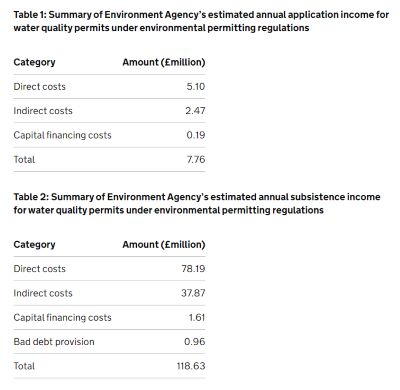
Estimated annual income
Based on the final proposed charges, the proportional split of the EA’s estimated income (which is assumed over a 12-month period) for applications and subsistence is as follows:
The EA has not proposed to increase the charge to vary a permit for event duration monitoring of combined sewer overflows or emergency overflows for AMP6 and AMP7 schemes. Details of the variation type for AMP8 schemes to water and sewerage companies will be confirmed through the usual technical and management liaison routes.
During the consultation EA customers from the water industry sector expressed concern about timescales with proposals being put forward shortly before the start of the next financial year, saying this did not give them enough time to adjust their budgeting and business plans.
EA: "For some time, water companies have been underperforming with regards to their environmental measures"
In response, the Agency said:
“The timing of our consultation on charges for water discharges is a direct and reactive result of instruction given by the government for us to increase our regulation of the water industry to help improve water quality. For some time, water companies have been underperforming with regards to their environmental measures, as has been covered in the media and by environmental non-governmental organisations.
“We acknowledge that consultees from all sectors have raised concerns regarding timing and we understand the pressure this will put on individuals and businesses. However, we need to recover full costs for regulation across water discharges and groundwater activities and we need to respond to demands for better regulation of the water industry. To allow us time to consider these points and the options available to us, we have delayed the introduction of our new charges until 1 June 2024 (rather than 1 April 2024 as indicated in the consultation).
“We acknowledge there will be a short-term pressure for water and sewerage companies to react to charge increases for year 5 of AMP7 (2024/25). We carried out targeted early engagement in the lead up to this consultation to support water and sewerage companies, ensuring they were given as much notice as possible. We do understand this concern, but it is necessary for us to introduce these new charges as soon as possible to fund the achievement of regulatory transformation.”
Going forward, to ensure the charges keep track of cost changes so the EA can maintain full cost recovery, the Agency will update all its charges annually on 1 April in line with inflation.
The impacts of increased charges have been calculated by Ofwat to result in an average charge uplift of around £1.90 per household annually, although the impact on customer bills will vary between companies.
“It is likely that water and sewerage companies’ customer bills will increase over the coming years to fund long-term environmental investment programmes. In comparison, the uplift for increased environmental scrutiny and regulation is small,” the Agency said.
The Environment Agency (Environmental Permitting and Abstraction Licensing) (England) Charging Scheme 2024 will come into force on 1 June 2024. The charging scheme has been approved by the Secretary of State for Environment, Food and Rural Affairs, Defra and HM Treasury.
The charges are issued under the Environmental Permitting (England and Wales) Regulations 2016 and have not been revised since 2018.


Sign In
